



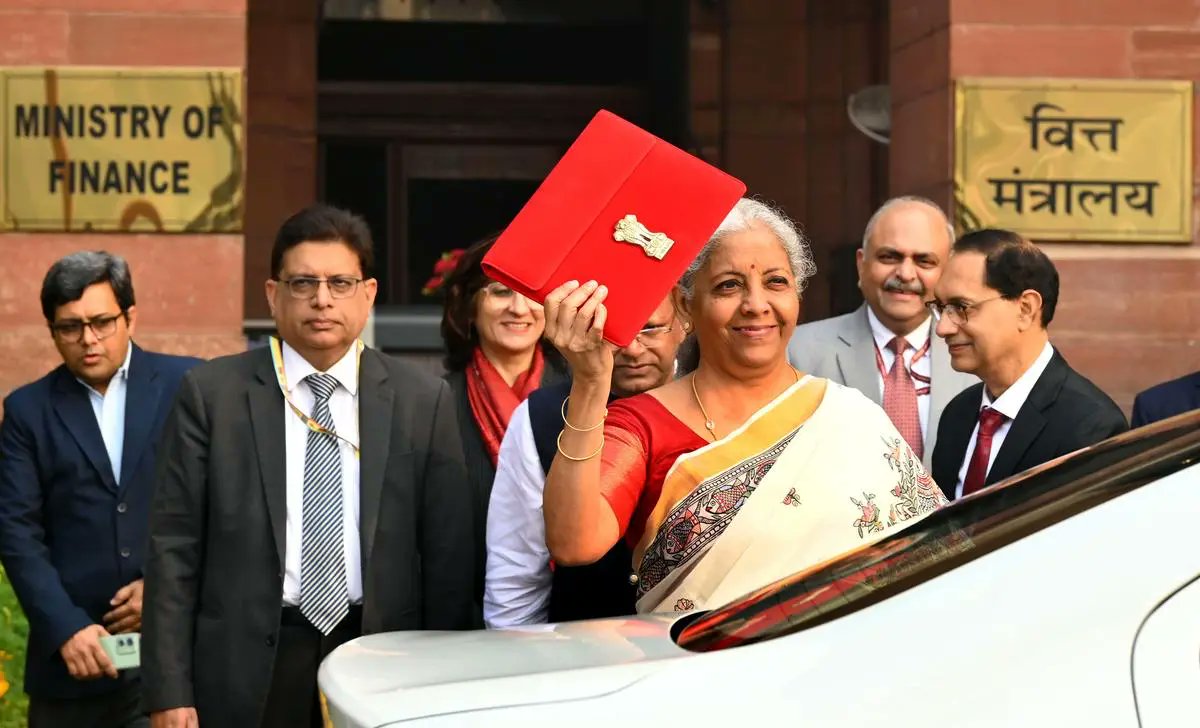
The presentation of the Union Budget 2026-27 by Finance Minister Nirmala Sitharaman turned into a rollercoaster for Indian investors during a rare Sunday trading session. While the budget laid out a long-term roadmap for a “Viksit Bharat,” the immediate reaction on Dalal Street was one of sharp risk aversion. According to data tracked by Savitimes, the BSE Sensex plummeted by 1,843 points, while the NSE Nifty50 closed well below the 25,000 mark. Despite the visible panic, members of the Prime Minister’s Economic Advisory Council (EAC-PM) have remained unfazed, characterizing the slump as a temporary correction driven by speculators rather than a reflection of India’s economic fundamentals.
The STT Hike: The Primary Catalyst for the Crash
The most significant factor behind the Union Budget 2026 market crash was the unexpected proposal to increase the Securities Transaction Tax (STT) on derivative trades. In her speech, the Finance Minister announced that the STT on futures would rise from 0.02% to 0.05%, while the tax on options premiums would climb to 0.15%. This move is part of a broader government effort to curb what officials term as “rampant speculation” in the futures and options (F&O) segment, which has seen an explosion of retail participation in recent years.
The impact was immediate and localized within the financial services sector. Brokerage stocks and exchange-related entities like BSE Ltd, Angel One, and the parent company of Groww (Billionbrains Garage Ventures) saw their valuations nosedive by as much as 13.5% in a single day. Industry analysts suggest that higher transaction costs will likely compress trading volumes and impact the near-term revenue visibility of these intermediaries. This “STT bombshell” overshadowed many of the budget’s positive infrastructure and manufacturing outlays during the live session.
EAC-PM Perspective: Brushing Off the Budget Day Crash
Nilesh Shah, a part-time member of the Economic Advisory Council to the Prime Minister and Managing Director of Kotak Mahindra Asset Management, offered a calming perspective on the volatility. He noted that the Indian markets had already been trading at high valuations, making them susceptible to “knee-jerk reactions” from the speculative community. From the Council’s view, the current Union Budget 2026 market crash is a temporary bruise to investor confidence that does not derail the steady, reform-driven economic trajectory the government has set.
Shah emphasized that the budget’s focus on fiscal prudence—including a declining debt-to-GDP ratio and a credible fiscal deficit target of 4.3%—provides a much stronger foundation for long-term growth. The EAC-PM maintains that while speculators are reacting to increased costs, long-term investors should focus on the record ₹12.2 trillion capital expenditure (Capex) allocation. This massive public spending is designed to act as a multiplier for the economy, prioritizing freight corridors, high-speed rail, and new waterways that will benefit India for the next decade.
Sectoral Winners and Losers in the Post-Budget Landscape
Beyond the headline indices, the budget created a sharp divide between different sectors of the economy. PSU Banks emerged as the biggest laggards, with the sectoral index falling over 4% due to uncertainty surrounding a new high-level committee appointed to review the banking sector. Heavyweights like State Bank of India (SBI) and Reliance Industries also contributed heavily to the downward pressure on the Sensex.
⏭️⏭️Pakistan T20 World Cup Boycott: Analyzing the 2026 Standoff and Its Global Impact
Conversely, defensive sectors managed to find some footing. Information technology (IT) stocks saw buying interest following proposals related to “safe harbour” thresholds, which are expected to reduce litigation and compliance costs for major exporters. The biopharma and textile sectors also received a boost from initiatives like “Biopharma Shakti” and the creation of new mega textile parks. Savitimes research indicates that while the “speculative froth” is being cleared out by the STT hike, quality stocks with high policy visibility remain attractive for long-term portfolios.
| Market Metric | Pre-Budget High | Budget Day Close | Percentage Change |
| BSE Sensex | 82,726.65 | 80,722.94 | -1.9% (approx) |
| NSE Nifty50 | 25,440.90 | 24,825.45 | -2.0% (approx) |
| India VIX | 13.35 | 15.10 | +13% |
Source: NSE/BSE Special Trading Session Data (Feb 1, 2026)
Future Outlook for Investors
The consensus among government advisors and institutional experts is that the Union Budget 2026 market crash serves as a “reasonable course correction” for the capital markets. By prioritizing long-term capital formation over short-term speculative momentum, the government is attempting to build a more resilient financial ecosystem. For readers of Savitimes, the message from the EAC-PM is clear: the volatility is noise, but the infrastructure-led growth strategy is the signal.
As the markets digest the fine print of the new Income Tax Act of 2025 and the adjusted STT rates, the focus will shift back to corporate earnings and global macroeconomic cues. While the Sunday crash was historic in its timing and magnitude, the underlying “reform, perform, and transform” philosophy remains the driving force behind India’s quest for a $5 trillion economy.